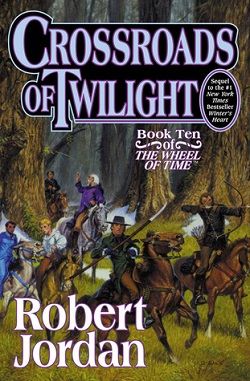
Crossroads of Twilight, the tenth installment in Robert Jordan's monumental series The Wheel of Time, continues the intricate tapestry of characters and plotlines that have captivated readers for nearly a decade. As the series approaches its climax, this volume serves as a pivotal moment, deepening the complexities of its characters while exploring themes of loyalty, power, and the burdens of destiny.
At the heart of this novel is Mat Cauthon, who finds himself in a precarious situation after fleeing Ebou Dar with the Daughter of the Nine Moons, a woman he is fated to marry. Mat's journey is emblematic of the overarching theme of Crossroads of Twilight: the struggle between personal desire and the weight of prophecy. Mat's character development is particularly compelling in this book; he is torn between his instinct to protect his own freedom and the responsibilities thrust upon him by fate. The tension between his desire for autonomy and the inevitability of his destiny creates a rich narrative that resonates with anyone who has grappled with the expectations placed upon them.
Perrin Aybara's storyline is equally poignant, as he embarks on a desperate quest to rescue his wife, Faile, from the clutches of the Shaido. This subplot delves into the theme of love as a double-edged sword. Perrin's willingness to ally with the enemy in order to save Faile raises profound questions about loyalty and sacrifice. His internal conflict—balancing his commitment to Rand and his love for Faile—illustrates the moral complexities that Jordan masterfully weaves throughout the series. Readers witness Perrin's evolution from a reluctant hero to a man willing to confront his own darkness, making his journey one of the most emotionally charged arcs in the book.
Meanwhile, Egwene al'Vere's ascent as the Amyrlin of the rebel Aes Sedai adds another layer of intrigue. Her efforts to reunite the Aes Sedai reflect the broader theme of unity versus division, a recurring motif in the series. Egwene's strategic mind and determination to minimize bloodshed highlight her growth from a naive village girl to a formidable leader. Her siege on Tar Valon is not just a physical battle; it is a struggle for the soul of the Aes Sedai and, by extension, the world. The stakes are high, and Egwene's character embodies the hope that unity can be achieved even in the face of overwhelming odds.
Elayne Trakand's fight for the Lion Throne of Andor further emphasizes the theme of power and its consequences. As she navigates a treacherous political landscape filled with enemies and Darkfriends, Elayne's character showcases the challenges faced by women in positions of authority. Her determination to claim her rightful place as queen is a testament to her strength and resilience. Jordan's portrayal of Elayne is particularly noteworthy; she is not merely a damsel in distress but a proactive character who actively shapes her destiny, reflecting the evolving role of women in fantasy literature.
Rand al'Thor, the Dragon Reborn, remains at the center of the narrative, grappling with the implications of having cleansed the Dark One's taint from saidin. His journey is fraught with uncertainty, as he must navigate the treacherous waters of trust and betrayal. The psychological toll of his role as the savior of the world is palpable, and Jordan does an exceptional job of illustrating Rand's internal struggles. The fear and hatred directed towards male channelers serve as a poignant commentary on societal prejudices, making Rand's plight all the more relatable. As he gambles with his own life and the lives of those he loves, readers are left questioning the true nature of heroism and the sacrifices it demands.
One of the most striking aspects of Crossroads of Twilight is Jordan's ability to create a sense of urgency and tension, even in moments of relative calm. The pacing of the novel may feel slower compared to earlier installments, but this deliberate approach allows for deeper character exploration and world-building. The intricate political machinations and personal dilemmas faced by the characters contribute to a rich narrative tapestry that rewards patient readers. Jordan's prose is as immersive as ever, painting vivid landscapes and crafting intricate dialogue that brings his characters to life.
In comparison to other epic fantasy series, such as George R.R. Martin's A Song of Ice and Fire or J.R.R. Tolkien's The Lord of the Rings, The Wheel of Time stands out for its focus on character development and the moral complexities of its protagonists. While Martin's work often emphasizes the brutal realities of power and betrayal, Jordan's narrative leans towards the exploration of hope and redemption, even amidst darkness. This thematic distinction makes Crossroads of Twilight a unique entry in the genre, appealing to readers who seek depth and nuance in their fantasy literature.
In conclusion, Crossroads of Twilight is a masterful continuation of Robert Jordan's epic saga. With its rich character development, intricate plotlines, and profound themes, the novel invites readers to reflect on the nature of destiny, love, and the struggle for power. As the series approaches its climax, this installment serves as a crucial turning point, setting the stage for the inevitable confrontation with the Dark One. For fans of the series, this book is not just a continuation; it is a testament to Jordan's skill as a storyteller and his ability to craft a world that feels both vast and intimately personal.