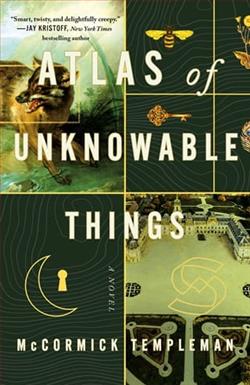
McCormick Templeman’s Atlas of Unknowable Things is a masterful blend of gothic intrigue and modern mystery, set against the hauntingly beautiful backdrop of the Rocky Mountains. The novel invites readers into the enigmatic world of Hildegard College, a place where the boundaries between the known and the unknowable blur, and where the pursuit of knowledge can lead to unexpected and sometimes unsettling revelations.
At the heart of the story is Robin Quain, a historian whose quest for an elusive artifact propels her into the depths of Hildegard’s secrets. Robin is a compelling protagonist, driven by both professional ambition and personal rivalry. Her character is richly developed, with Templeman skillfully unraveling her motivations and vulnerabilities as the narrative progresses. Robin’s journey is not just a physical search for an artifact but also an introspective exploration of her own past and the choices that have led her to this point.
The setting of Hildegard College is a character in its own right, with its secluded campus and sprawling botanical gardens providing a lush and atmospheric backdrop for the unfolding drama. Templeman’s descriptions are vivid and evocative, painting a picture of a place that is both beautiful and eerie. The college’s scientific innovation is juxtaposed with its gothic elements, creating a tension that permeates the novel. The strange sounds, flickering lights, and mysterious faculty members add layers of mystery and suspense, keeping readers on edge as they, like Robin, seek to uncover the truth.
One of the novel’s most intriguing aspects is its exploration of the theme of knowledge and its limits. The title, Atlas of Unknowable Things, suggests a map of the unknown, and Templeman delves into the idea that some things may be beyond human understanding. This theme is woven throughout the narrative, as Robin’s research leads her into areas of historical, botanical, and occult significance. The novel raises thought-provoking questions about the nature of knowledge and the human desire to seek meaning in the scientific and the sublime.
The gothic tradition is evident in Templeman’s writing, with its emphasis on atmosphere, mystery, and the supernatural. Fans of The 7½ Deaths of Evelyn Hardcastle will find much to appreciate in this novel, as it shares a similar sense of intrigue and complexity. However, Templeman brings a unique modern twist to the gothic genre, infusing it with contemporary themes and a fresh perspective. The result is a novel that feels both timeless and timely, resonating with readers who enjoy stories that challenge the boundaries of reality and imagination.
Character development is another strength of the novel. Robin’s interactions with other characters, including her former best friend turned rival, are nuanced and layered. The dynamics between them add depth to the story, revealing the complexities of friendship, competition, and betrayal. The enigmatic professor who vanished adds another layer of mystery, and her absence is felt throughout the novel, as Robin seeks to understand her role in the college’s secrets.
Templeman’s writing is both lyrical and precise, capturing the beauty and danger of the natural world as well as the intricacies of human relationships. The pacing of the novel is well-balanced, with moments of tension and suspense interspersed with quieter, reflective passages. This rhythm allows readers to become fully immersed in the story, experiencing the highs and lows of Robin’s journey alongside her.
In comparison to other works in the genre, Atlas of Unknowable Things stands out for its originality and depth. While it shares thematic elements with novels like The Secret History by Donna Tartt and The Shadow of the Wind by Carlos Ruiz Zafón, Templeman’s novel is distinct in its focus on the intersection of science and the supernatural. The novel’s exploration of the unknown and the unknowable is both intellectually stimulating and emotionally resonant, offering readers a rich and rewarding experience.
Overall, Atlas of Unknowable Things is a captivating and thought-provoking novel that will appeal to fans of gothic literature and modern mysteries alike. McCormick Templeman has crafted a story that is both a thrilling adventure and a profound meditation on the nature of knowledge and the human spirit. As Robin Quain navigates the mysteries of Hildegard College, readers are invited to join her on a journey of discovery, where the answers may be as elusive as the questions themselves.
In conclusion, Templeman’s novel is a testament to the power of storytelling, weaving together elements of history, science, and the supernatural to create a narrative that is as compelling as it is enigmatic. Atlas of Unknowable Things is a book that will linger in the minds of readers long after the final page is turned, a reminder of the beauty and mystery that lies at the heart of the human experience.