Page 168 of Bound By Honor
“Only two, my lord, Sir William Vipont and Sir Walter Ross.” Angus recalled the Earl of Ross, who had submitted to King Robert at Urquhart Castle. Sir Walter was one of his sons.
While Sir Robert was still speaking, Sir Neil Campbell approached. “A messenger arrived while you were away, my king. It seems the Earl of Hereford and other nobles escaped and headed for Carlisle. With him were the Earl of Angus, Sir John de Segrave, Sir Antony de Lucy, Sir Ingram de Umfraville, and many other knights, numbering over a hundred, as well as many foot soldiers. At Bothwell Castle, they appealed to the constable, Sir Walter Fitz Gilbert, who was holding the castle for England’s king. Fitz Gilbert admitted them and quickly took them prisoners. His message to us said the castle is yours, and he asked for Sir Edward to come and retrieve his English ‘guests’. Your brother has gone with a large force to bring them back.”
“These will have rich ransoms, indeed,” said Angus.
“Enough, mayhap, to win me my queen,” said King Robert.

“There is news of Aymer de Valence,” said Sir Robert. “He got away with his Welsh archers but he must have lost his last horse because Pembroke was seen running on foot.”
“A fitting end to his many losses following his unchivalrous behavior at Methven,” said Angus.
“At last, my brave friends who died at his hand are avenged,” said the king.
That night, Angus slept soundly, exhausted from little sleep the night before and two days of fighting, though admittedly he had not fought for the entire battle as had some.
The next day, he was up with the birds and broke his fast with his chiefs before setting out to see the king. The king’s brother and James Douglas had yet to return from their missions. King Robert was hearing a report from Sir Neil Campbell of the booty taken from King Edward’s baggage train.
“There are one hundred and ten wagons, Sire. Beautiful horses, flocks of cattle and sheep, pigs and poultry, corn and wine in abundance, sumptuous clothing from the royal wardrobe, armor for the nobles and knights, vessels and utensils of silver and gold, and money chests with coin for the payment of the army.”
“So much!” exclaimed the king. “We are rich, indeed.”
“What will you do with it?” asked Sir Robert Boyd.
The king smiled. “Why, I will distribute it to my captains and the men who have fought with me for so long. That includes all of you,” he said, looking at the small group that never left him. “And the coin will help pay our army and keep the realm stable.”
The king was true to his word, so that the whole Scots army was enriched by the victory. Beyond that, the king said he would be distributing lands to his faithful men.
To Angus, the king said, “I trust you have no problem with my retaining and fortifying as a royal castle Tarbert at the north end of Kintyre.”
“None at all,” said Angus. “It will be good to have you close as you find time to visit.”
“Next year,” said the king, “I will come to your Isles, mayhap with my queen, to bring you the charters to the lands I intend to bestow upon you. Since your cousin, Duncan, has faithfully served me and makes his home on Kintyre at Saddell, I will see him rewarded as well. There is an abbey at Saddell whose mission I may be able to assist. Tell him, too, that I will make sure the lass he has been courting has a worthy dowry.”
“I will,” said Angus. Angus thanked the king and, later that morning, told Duncan of his good fortune.
“I shall see about wedding the lass as soon as I can,” said his cousin.
“Well, and you might introduce her to us,” said Angus.
“Aye, if you insist,” said Duncan with a smile.
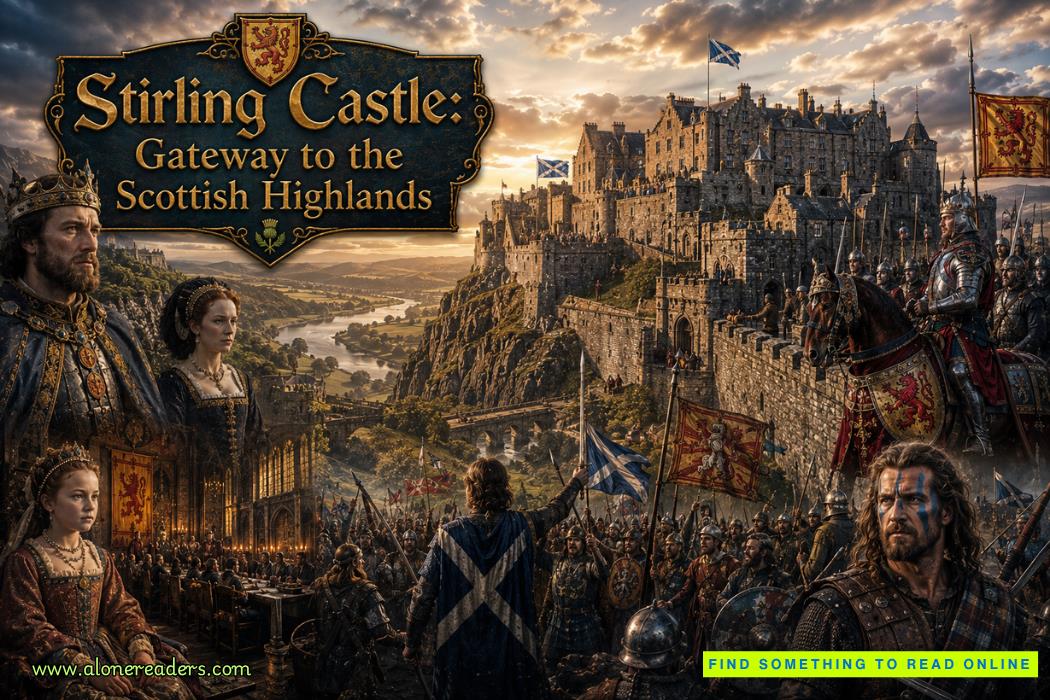
Late in the afternoon, Sir Philip Mowbray surrendered Stirling Castle and swore fealty to King Robert. Unbeknownst to the king, Mowbray had tried to persuade King Edward not to fight the Scots. “I watched you preparing your army and the land for battle. I knew the English would lose.”
Douglas finally returned, weary from his long journey and, like his men, covered with dried blood from battle and dirt from the road. “As I reached the border of Torwood, I met Sir Lawrence de Abernethy.” Douglas gestured to the man beside him. “He was coming to assist the English but, learning of the battle’s end, quickly changed sides and joined me, adding his eighty men to my sixty. At Linlithgow, we came within bowshot of King Edward and his party, but lacked the force to attack them. Instead, we hung on their tail and captured or killed the stragglers.”
“He did not even allow the English time to make water,” said Sir Lawrence with a chuckle.
“Sounds like our Douglas,” put in Angus.
“When Edward found shelter at Dunbar Castle,” said Douglas, “we left off our pursuit. The English king would not admit to the castle those English who followed after him, but abandoned them to their fate. We let them go on to Berwick, but I brought back many horses.”
“You did well,” said the king. “I am glad you have returned to me unscathed.”
Angus remained at Stirling only as long as King Robert needed him. When he was ready to go home, he asked his friend, “Do you wish Duncan to remain with you when I sail for Islay?”
“For the time being, yes. I will return him to you next year when I come. Mayhap, by then, he will have wed and you will have reclaimed Dunaverty Castle.”
“My very thought,” said Angus.