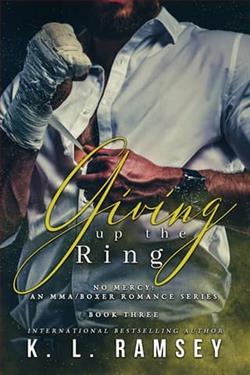
Page 70 of Give In to Me
My name first, then the rest, spoken into the dark of our bedroom with her hands on my face and her forehead against mine, and I won’t describe what happened in this room because some things belong only to the two people who were in them, and I’ve spent my entire life protecting what matters by keeping it out of the light.
I’ll say this: she shook. I shook. The distance between us—the one I measured in lecture halls and office doorways and museum corridors, the distance I maintained with the discipline of a man who believed proximity was a form of violence—that distance became zero, and the zero didn’t destroy me. It remade me.
And afterward, with her head on my chest and her finger tracing circles on my shoulder—the same circles, the same slow loops, the geometry of a girl who holds herself together by drawing on surfaces—I said it back. The first time. In Italian, because my heart still speaks the old language when it speaks at all, and then in English, because she deserves to hear it in the language she thinks in.
Ti amo. I love you.




She pressed her face into my chest and her hand went still—the circles stopped—and for a moment I thought I had broken something, the way I always think I’ve broken something, because the boy from the stone room is still in here and he still expects everything good to shatter when he touches it.
Then her finger started again. One circle. Slow. Wide. The peace rhythm.
She fell asleep drawing circles on my skin, and I lay in the dark with her weight on my chest and her breath on my neck and the Nebraska night outside the window, and I didn’t sleep, because some things are too valuable to miss even one minute of.
THE PHONE VIBRATEDat six.
Luciano felt it before he heard it—three short pulses against the nightstand, a pause, three more. A number he kept in a phone thathadno other numbers in it, because compartmentalization wasn’t a habit he ever planned to break.
He slid out of bed the way he had moved his entire life—without sound, without disturbance, a body trained to leave rooms as though it had never been in them. Elsa stirred. Her hand found the warm indent where he had been and rested there, fingers curling around nothing, and something behind his ribs pulled tight at the sight of it.
He closed the door quietly and stepped onto the porch.
Nebraska in early morning was a specific kind of cold—clean, wide, the air tasting of soil and distance. He could see the Lively farmhouse from here, a quarter mile down the road, the porch light on because Martha left it on all night. Because MarthaLively was the kind of woman who left a light on in case someone needed to find their way home.
He answered the phone.
“It’s done.”
SIX HUNDRED MILES SOUTHand an ocean east, Andrei Almazov stood at the floor-to-ceiling window of his office in Ace Royale and watched the Mediterranean do what it did at dawn—turn from black to iron to a pale, wounded silver that reminded him, every single morning, of the colour of her eyes whenshewas angry.
Ciana’s eyes were grey. Not the soft grey of overcast skies or morning fog. The grey of a blade edge. The grey of a woman who had looked at him across a champagne flute at forty thousand feet and seen everything he was and hadn’t flinched, and then looked at him again whenshefound out he had bought her airline, and had flinched, and the flinch had nearly killed him.
He pressed the phone to his ear. Luciano’s voice came through—low, Italian-accented, carrying the particular weight of a man who had recently been rebuilt by something gentle. Andrei had heard that weight before. In his own voice, in the galley of a jet grounded in Geneva, when he had said a woman’s name for the first time and meant it the way prayer means it.
“The holding company?” Luciano asked.
“Restructured. Three layers between the acquisition and the family name. Your perimeter held. No one traced it.”
“Good.”




A pause settled between them. Andrei’s pauses were geological—other men filled silence because it made them uncomfortable. Andrei filled silence with the weight of everything he was choosing not to say.
He was choosing not to say that the flight tracker on his desk was open. That it was always open. That the blue dot representing Côte d’Azur Atlantic Flight 412—Nice to Athens, departing in four hours—was the first thing he looked at every morning and the last thing he looked at every night, and that the woman working that flight had no idea he still watched her route the way a man watches a heartbeat on a monitor, terrified it’ll stop.
He was choosing not to say thatCianaReyes had transferred off his jet eleven weeks ago and he couldstillsmell her in the cabin. Cedar and something clean, something that was just her, embedded in the leather of the seat she never sat in and the galley counter she polished every flight and the air that had held the shape of her presence and refused to let it go.
Eleven weeks. He had bought a three-hundred-million-euro airline to keep her close, and she had walked away with a transfer request and a spine made of steel, and he had approved the transfer because she had asked him to and he had never once in his life been able to deny Ciana Reyes anything except the one thing she actually wanted.
Him.
“She’s still flying,” Andrei said. He didn’t need to clarify who. There was only one she between them, the way there had only been one she in every conversation Andrei had had for the past year. Ciana had colonized his language the way she had colonized everything else—quietly, completely, without permission.
On the porch in Nebraska, Luciano leaned against the rail. The wood was cold under his forearms. “The flight attendant.”
“Yes.”
“And?”
Another pause. Longer. Andrei stared at the blue dot on his screen. In four hours, Ciana would walk through the cabin of a commercial aircraft—not his jet, not the matte-black A350 he had rebuilt for one, but a standard first-class cabin with six passengers instead of him alone—and she would pour champagne with effortless grace and smile that cabin-professional smile and no one on that flight would know that the man who owned the airline was six hundred miles away, watching her route on a screen, unable to stop.